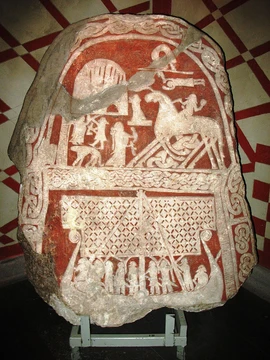
Yggdrasil
Immense sacred ash tree central to Norse cosmology.

Yggdrasil is an immense and central sacred tree in Norse cosmology, around which all else exists, including the Nine Worlds. It is attested in the Poetic Edda and the Prose Edda, both compiled in the 13th century, and is considered very holy by the gods, who assemble at it daily.
- Mythology
- Norse
- Type
- Sacred tree (ash tree)
- Attested in
- Poetic Edda, Prose Edda (13th century)
- Also known as
- Hoddmímis holt, Mímameiðr, Læraðr
- Associated deity
- Odin
- Creatures dwelling within
- Níðhöggr, Ratatoskr, Veðrfölnir, Dáinn, Dvalinn, Duneyrr, Duraþrór
Lore & Background
Yggdrasil is an immense ash tree that is central to the cosmos and considered very holy. The gods go to Yggdrasil daily to assemble at their traditional governing assemblies. Its branches extend far into the heavens, and the tree is supported by three roots that extend far away into other locations: one to the well Urðarbrunnr in the heavens, one to the spring Hvergelmir, and another to the well Mímisbrunnr. Creatures live within Yggdrasil, including the dragon Níðhöggr, the squirrel Ratatoskr, the hawk Veðrfölnir, and the stags Dáinn, Dvalinn, Duneyrr and Duraþrór. The generally accepted meaning of Old Norse Yggdrasill is 'Odin's horse', meaning 'gallows'. This interpretation comes about because drasill means 'horse' and Ygg(r) is one of Odin's many names. The Poetic Edda poem Hávamál describes how Odin sacrificed himself by hanging from a tree, making this tree Odin's gallows. Scholarly opinions regarding the precise meaning vary, including interpretations as 'tree of terror, gallows' or 'yew pillar'. Anatoly Liberman argues the name originally referred to Odin's literal horse (later known mainly as Sleipnir). In the Poetic Edda, Yggdrasil is mentioned in Völuspá, Hávamál, and Grímnismál. In Völuspá, a völva recalls when Yggdrasil was a seed, and later describes three maidens (Urðr, Verðandi, Skuld) who come from a lake under the tree to decide destinies. In Hávamál, Odin describes sacrificing himself by hanging on a tree, widely accepted as Yggdrasil. In Grímnismál, Odin provides details about the tree's three roots, the squirrel Ratatoskr, four harts, and serpents beneath it. In the Prose Edda, Yggdrasil is described as the biggest and best of all trees, with branches extending over all the world and reaching over the sky.
Reader's Guide
Yggdrasil is a foundational symbol in Norse mythology, representing the interconnectedness of the cosmos. As the world tree, it supports the Nine Worlds and serves as the meeting place for the gods, who hold their daily assemblies there. Its three roots connect to different realms and wells, each with profound significance: Urðarbrunnr (the well of fate), Mímisbrunnr (the well of wisdom), and Hvergelmir (the spring of primordial waters). The creatures that inhabit Yggdrasil—such as the dragon Níðhöggr gnawing at its roots, the squirrel Ratatoskr carrying messages, and the stags eating its branches—illustrate the constant cycle of decay and renewal within the cosmos. The etymology of Yggdrasil is debated among scholars, with the most common interpretation linking it to Odin's self-sacrifice on a gallows, which he called his 'horse.' This connection underscores the tree's role as a site of transformation and knowledge. The tree is also an example of sacred trees and groves in Germanic paganism, and its study has long been a topic in Germanic philology. Yggdrasil's legacy endures as a powerful symbol of life, death, and cosmic order, influencing modern literature, art, and neopagan traditions.
Did You Know?
- Yggdrasil is an immense ash tree central to Norse cosmology, around which the Nine Worlds exist.
- The generally accepted meaning of Old Norse Yggdrasill is 'Odin's horse', meaning 'gallows'.
- Creatures living within Yggdrasil include the dragon Níðhöggr, the squirrel Ratatoskr, the hawk Veðrfölnir, and four stags.
- Scholars consider Hoddmímis holt, Mímameiðr, and Læraðr to be other names for the tree.
Common Misconceptions (Editorial)
People sometimes assume Yggdrasil is merely a symbolic or metaphorical tree, but the source texts describe it as a literal, immense ash tree central to the cosmos where the gods assemble daily. Another common misconception is that Yggdrasil’s name means "world tree" in a general sense, whereas the generally accepted meaning is "Odin’s horse," referring to a gallows. Additionally, while many believe the tree is peaceful, it actually harbors creatures like the dragon Níðhöggr and the squirrel Ratatoskr within its branches and roots.
Why It Matters (Editorial)
Yggdrasil endures because it embodies the ancient Norse vision of a living, interconnected cosmos—where gods, humans, and even dragons share a single sacred structure. Its image of a great ash tree holding together the Nine Worlds speaks to a universal human need to find order and meaning in the universe, which is why it still resonates in modern culture, from literature to video games.
Spotted an error? Know more?
This is a living reference — every entry is fact-audited, and reader corrections feed straight into our audit queue. Suggest an edit · See this site's audit record