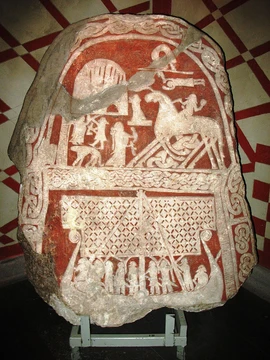
Sleipnir
Eight-legged steed of Odin, born of Loki.

Sleipnir is an eight-legged horse in Norse mythology, ridden by the god Odin. Described as the best of all horses, Sleipnir is attested in the Poetic Edda and the Prose Edda, both compiled in the 13th century, and is notable for being the offspring of the god Loki and the stallion Svaðilfari.
- mythology
- Norse
- type
- Horse
- owner
- Odin
- parentage
- Child of Loki and Svaðilfari
- color
- Grey
- notable_for
- Eight legs; best of all horses; ridden to Hel
Lore & Background
Sleipnir appears in several poems of the Poetic Edda, including Grímnismál, where Odin states that Sleipnir is the best of horses. In Baldrs draumar, Odin saddles Sleipnir and rides to Hel. The Prose Edda provides the fullest account of Sleipnir's birth: during the building of Asgard's wall, Loki, in the form of a mare, lured the stallion Svaðilfari away from the builder, and later gave birth to the grey, eight-legged foal Sleipnir. Sleipnir is also ridden by Hermóðr in an attempt to ransom the god Baldr from Hel.
Reader's Guide
Sleipnir holds a unique place in Norse mythology as both a divine steed and a product of Loki's shape-shifting. The horse's eight legs have been interpreted by scholars as a possible symbol of shamanic journeying, linking Odin's rides to the realm of the dead with ecstatic trance practices. Sleipnir appears in later Icelandic folklore as the creator of the canyon Ásbyrgi, said to have been formed by a hoofprint. The horse is also depicted on two 8th-century Gotlandic image stones, the Tjängvide and Ardre VIII stones, indicating early iconographic importance. In modern culture, Sleipnir has been referenced in art, literature, software, and ship names, reflecting enduring fascination with this unusual and powerful creature.
Did You Know?
- Sleipnir is the child of Loki and the stallion Svaðilfari.
- Sleipnir is described as grey in color in the Prose Edda.
- Sleipnir is generally accepted as depicted on two 8th-century Gotlandic image stones.
- In Icelandic folklore, Sleipnir is said to have created the canyon Ásbyrgi.
The Birth of an Eight-Legged Wonder
The Prose Edda's Gylfaginning preserves one of Norse mythology's most elaborate origin tales. In the early days of the gods' settlement, an unnamed builder offered to construct a fortification for the Æsir within three seasons, demanding Freyja, the sun, and the moon as payment. The gods agreed under strict conditions, but Loki's influence led them to permit the builder to use his stallion Svaðilfari. The horse performed feats of extraordinary strength, hauling massive rocks and keeping the work far ahead of schedule. With three days remaining, the builder was nearly finished. Panicked, the gods turned to Loki, who swore to sabotage the project at any personal cost. That night, a mare emerged from a wood and neighed at Svaðilfari. The stallion, recognizing the mare's nature, tore free of his harness and chased her into the forest. The builder pursued them both, and the building halted for the entire night. The gods, recognizing the builder as a hrimthurs, called Thor, who shattered the builder's skull with Mjöllnir. Yet Loki had such dealings with Svaðilfari that he later gave birth to a grey, eight-legged foal—Sleipnir, declared the finest horse among gods and men.
Odin's Steed and the Road to Hel
Sleipnir is consistently identified across sources as Odin's personal horse and the finest of all equines. In the Poetic Edda's Grímnismál, the disguised Odin tells the boy Agnar that while he is the best of the Æsir, Sleipnir is the best of horses. The Prose Edda's Gylfaginning opens its list of the Æsir's horses with Sleipnir, noting his eight legs and his ownership by Odin. The steed's most dramatic role comes in the aftermath of Baldr's death. In Baldrs draumar, Odin saddles Sleipnir and rides to Hel's realm. In Gylfaginning chapter 49, it is Hermóðr who mounts Sleipnir for the journey, riding nine nights through dark valleys where nothing can be seen. They cross the river Gjöll and its bridge, where the guardian Móðguðr remarks that five battalions of dead have recently passed with less noise than this rider. At Hel's gates, Sleipnir leaps so powerfully over the entrance that the gate barely registers the passage. After Hermóðr secures Baldr's release under a condition, the pair retraces their route back to Asgard.
A Figure Across the Medieval Record
Sleipnir's presence in the surviving Norse sources is remarkably wide-ranging. In the Poetic Edda, the horse appears in four distinct poems: Grímnismál, Sigrdrífumál (where runes are to be cut on Sleipnir's teeth), Baldrs draumar, and Hyndluljóð, which records Loki's union with Svaðilfari alongside his offspring with Angrboða. Beyond the Eddas, Sleipnir surfaces in the 13th-century Hervarar saga ok Heiðreks within a riddle, and in the Völsunga saga as the ancestor of the horse Grani. The 12th-century Gesta Danorum by Saxo Grammaticus contains an episode that many scholars connect to Sleipnir. Perhaps most strikingly, two 8th-century Gotlandic image stones—the Tjängvide stone and the Ardre VIII stone—are generally accepted by scholars as depicting the eight-legged horse, pushing the visual tradition back to the Viking Age.
From Shamanic Speculation to Modern Myth
Modern scholarship has explored the possibility that Sleipnir's eight-legged form and his connection to Loki reflect shamanic practices among Norse pagans, though these remain theoretical interpretations rather than established conclusions. In Icelandic folklore, Sleipnir takes on a creative role as the figure credited with forming the basalt cliff of Ásbyrgi. Beyond academic and folk contexts, the eight-legged horse has permeated modern culture: he appears in works of visual art and literature, features in software, and has been chosen as the name for ships. The Prose Edda also preserves a kenning calling Loki the relative of Sleipnir, a linguistic echo of the birth narrative that keeps the horse's origin woven into the broader web of Norse poetic tradition. Whether as a symbol of otherworldly travel, a marker of Loki's transformative nature, or simply the finest mount in the mythic cosmos, Sleipnir endures as one of the most recognizable figures in Norse imagination.
Common Misconceptions (Editorial)
- Some might assume Sleipnir was born naturally to two divine horses, but the facts confirm Sleipnir is the offspring of the god Loki and the stallion Svaðilfari, not of two ordinary or fully equine parents. - A common misconception is that Sleipnir is black or white, but the Prose Edda describes the horse as grey in color. - It is sometimes thought Sleipnir appears only in the Prose Edda, but the facts note he is attested in the Poetic Edda as well, including in the poems Grímnismál and Baldrs draumar.
Why It Matters (Editorial)
Sleipnir endures as a symbol of the Norse world’s blend of chaos and order, born from Loki’s trickery yet serving as Odin’s trusted steed to the realm of the dead. The eight-legged horse also appears on ancient Gotlandic stones and in Icelandic folklore, showing how a single mythical creature can bridge pagan imagery, medieval literature, and living folk tradition across centuries.
Spotted an error? Know more?
This is a living reference — every entry is fact-audited, and reader corrections feed straight into our audit queue. Suggest an edit · See this site's audit record