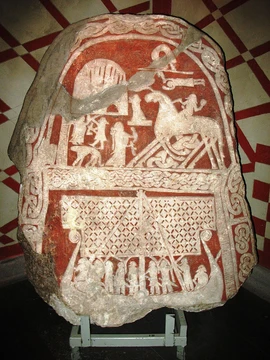
Heimdall
Watchman god who blows Gjallarhorn at Ragnarök.

Heimdall is a god in Norse mythology, known as the watchman of the gods who guards against invaders and the onset of Ragnarök from his dwelling Himinbjörg, where the rainbow bridge Bifröst meets the sky. He is attested in the Poetic Edda, Prose Edda, Heimskringla, skaldic poetry, and likely on a runic inscription from England, and is noted for his foreknowledge, keen senses, golden teeth, and the horn Gjallarhorn.
- field
- Norse mythology
- known_for
- Watchman of the gods, possessor of Gjallarhorn, originator of social classes among humanity
- also_known_as
- Rig, Hallinskiði, Gullintanni, Vindlér or Vindhlér
Lore & Background
Heimdall is the son of nine mothers and dwells at Himinbjörg, where the burning rainbow bridge Bifröst meets the sky. He possesses the resounding horn Gjallarhorn, the golden-maned horse Gulltoppr, and a store of mead. He is described as golden-toothed, 'the whitest of the gods,' and enigmatic statements such as 'the head is called his sword' appear in the sources. He is said to be the originator of social classes among humanity, as recounted in the poem Rígsþula, where he wanders as Rígr and fathers the progenitors of the classes. Heimdall has a notable antagonistic relationship with Loki; they are foretold to kill one another during Ragnarök. In one story, he recovers Freyja's treasured possession Brísingamen while doing battle in the shape of a seal with Loki. He is attested in the Poetic Edda (poems including Völuspá, Grímnismál, Lokasenna, Þrymskviða, Rígsþula, and Hrafnagaldr Óðins), the Prose Edda, Heimskringla, skaldic poetry, and likely on a runic inscription on the Saltfleetby spindle-whorl from England. Two lines of a lost poem, Heimdalargaldr, survive.
Reader's Guide
Heimdall's significance lies in his role as the ever-vigilant guardian of the gods, whose horn Gjallarhorn will announce the onset of Ragnarök. His enigmatic descriptions—golden teeth, being 'the whitest of the gods,' and the phrase 'the head is called his sword'—have prompted extensive scholarly interpretation. The etymology of his name is obscure, with 'the one who illuminates the world' proposed, and his alternative names (Hallinskiði, Gullintanni, Vindlér or Vindhlér) have generated theories about his connections to sheep, borders, and waves. His role as originator of social classes in Rígsþula ties him to human society, while his foretold mutual killing with Loki underscores the theme of cosmic conflict. The Saltfleetby spindle-whorl inscription suggests his worship or invocation may have persisted in Christian-era England. The uncertainty surrounding his nature—whether he is an Æsir or Vanir, and the meaning of his attributes—makes him a subject of ongoing scholarly debate.
Did You Know?
- Heimdall is the son of nine mothers, according to Norse mythology.
- He possesses the resounding horn Gjallarhorn and the golden-maned horse Gulltoppr.
- Heimdall is foretold to kill and be killed by Loki during Ragnarök.
- He is likely mentioned on the Saltfleetby spindle-whorl, a 10th- to 12th-century lead object found in England.
Heimdall Among the Æsir and the Naming of His Blade
In the pantheon of Norse mythology, Heimdall stands as one of the Æsir, the principal group of gods in the Scandinavian mythological tradition. Like many figures in these ancient narratives, he is associated with a specific named weapon: a sword called Hǫfuð. The broader corpus of Norse mythological references includes numerous such character-weapon pairings, where a particular blade or armament is tied to a particular hero or deity. What makes Heimdall's entry distinctive is how sparse it is. The oldest mythological references to named weapons sometimes provide nothing beyond the name itself, and Hǫfuð appears to fall into this minimal category. Unlike Thor's hammer Mjölnir, which receives more elaborate description in the sources, or Odin's spear Gungnir, which is said to always strike its intended target, Heimdall's sword is identified primarily by its name and its bearer. This brevity reflects the fragmentary nature of much of the surviving Norse mythological record, where some weapons receive rich narrative treatment while others are reduced to a single identifying label attached to their wielder.
The Etymology and Cross-Linguistic Resonance of Hǫfuð
The sword Hǫfuð carries a name that translates directly as "man-head" in Old Norse, a designation that immediately evokes the physical and perhaps symbolic weight of the weapon. What is particularly striking about this name is how it persists across the modern Scandinavian and North Germanic language family. The same root appears as hovud in Norwegian, hoved in Danish, huvud in Swedish, and höfuð in Icelandic, demonstrating that the word for "head" has remained remarkably stable across centuries and across the various branches of the Norse-descended languages. This linguistic continuity means that anyone speaking one of these modern tongues can still recognize the core meaning embedded in Heimdall's blade. In the context of Norse mythology, where weapons often carry names that hint at their properties or origins—such as Dáinsleif, meaning "Dáinn's Heirloom," or Gram, meaning "ill-tempered"—the straightforward anatomical reference of Hǫfuð stands apart. It does not invoke a maker, a curse, or a magical quality; it simply names a body part, leaving the full significance of the association to the reader's imagination.
Gylfaginning and the Fragmentary Record of Æsir Armaments
The sole surviving textual reference to Heimdall's sword Hǫfuð appears in Gylfaginning. This is a notably brief mention compared to the treatment other divine and heroic weapons receive in the same and related sources. In the broader Norse mythological corpus, some weapons are described with considerable narrative elaboration: Thor's Mjölnir is given a famous identity, and Odin's Gungnir is depicted across multiple texts including the Völuspá, Sigrdrífumál, Chapter 51 of Gylfaginning, and the Skáldskaparmál, with the added property that it always hits its target. By contrast, Heimdall's entry in Gylfaginning offers essentially a name and a bearer, with no further elaboration on the sword's properties, its forging, or any associated legends. This pattern—where the oldest references sometimes provide nothing beyond a weapon's name—means that Hǫfuð exists in the mythological record as a fragment, a single data point in a much larger web of named armaments that later storytellers and scholars have worked to contextualize within the broader narrative landscape of Norse tradition.
Norse Weapons in the Modern Cultural Imagination
The world of Heimdall and his sword Hǫfuð sits within a broader ecosystem of Norse mythological weapons that have been repeatedly reimagined in modern cultural adaptations. While the original sources often provide only a name and a wielder, later creators have expanded these references considerably. Richard Wagner's Ring cycle of operas, for instance, reimagines Odin's spear Gungnir as a vessel inscribed with every treaty and agreement Wotan has struck with other beings, effectively making it the repository and foundation of his divine authority. In contemporary media, Norse weapon names have proliferated across video games, anime, and other entertainment: Dáinsleif appears in the Castlevania series, Final Fantasy Type-0, Genshin Impact, Senki Zesshō Symphogear, Black Clover, and numerous other titles, sometimes as a sword, sometimes as a railgun, sometimes as a character name. Heimdall's Hǫfuð, by contrast, has not received the same level of modern cultural uptake. Its relative obscurity in popular adaptations reflects the brevity of its original source material, where a single mention in Gylfaginning provides far less narrative fuel than the richer accounts available for weapons like Mjölnir or Gungnir.
Common Misconceptions (Editorial)
- Some people mistakenly believe Heimdall only appears in the Poetic Edda, but the facts show he is also attested in the Prose Edda, Heimskringla, skaldic poetry, and likely on a runic inscription from England. - A common misconception is that Heimdall has no role beyond being a watchman, but the facts confirm he is also the originator of social classes among humanity, as recounted in the poem Rígsþula.
Why It Matters (Editorial)
Heimdall endures as a figure of vigilance and boundary-keeping, embodying the universal human need for watchfulness against chaos and destruction. His role in foretelling and facing Ragnarök, alongside his complex relationship with Loki, speaks to the enduring power of Norse mythology to explore fate, conflict, and the cycles of destruction and renewal.
Spotted an error? Know more?
This is a living reference — every entry is fact-audited, and reader corrections feed straight into our audit queue. Suggest an edit · See this site's audit record