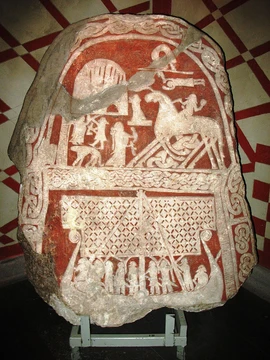
Loki
Norse trickster jötunn bound for Baldr's death, foretold to fight at Ragnarök, where the world is destroyed and reborn.

Loki is a jötunn (giant) in Norse mythology, attested in the Poetic Edda, Prose Edda, Heimskringla, the Norwegian Rune Poem, skaldic poetry, and Scandinavian folklore. He is a shape-shifter and trickster figure who plays a key role in the death of the god Baldr and in the events of Ragnarök, where he and his monstrous children help bring about the world's destruction and rebirth, though a few humans survive.
- born
- Not specified in source
- died
- Foretold to be killed by Heimdallr during Ragnarök
- field
- Norse mythology
- nationality
- Norse
- known_for
- Engineering the death of Baldr; father of Hel, Fenrir, and Jörmungandr; shape-shifting; role in Ragnarök
Lore & Background
Loki is the son of the jötunn Fárbauti and the goddess Laufey, and brother of Helblindi and Býleistr. He is married to the goddess Sigyn, with whom he has two sons, Narfi or Nari and Váli. By the jötunn Angrboða, Loki fathered Hel, the wolf Fenrir, and the world serpent Jörmungandr. In the form of a mare, Loki was impregnated by the stallion Svaðilfari and gave birth to the eight-legged horse Sleipnir. Loki is a shape-shifter, appearing also as a salmon, a fly, and an elderly woman named Þökk.
Reader's Guide
Loki's significance in Norse mythology is complex: he is a catalyst for conflict and destruction, yet also a necessary figure in the cosmic cycle of Ragnarök. He engineers the death of the beloved god Baldr, leading to his binding by the gods and suffering from serpent venom; his wife Sigyn collects the venom in a bowl, but when she empties it, the dripping venom causes Loki to writhe, causing earthquakes. At Ragnarök, Loki breaks free and fights alongside the jötnar, and he and Heimdallr kill one another. Scholars debate his origins and role, noting he likely received no veneration but played a notable mythic role, often described as a trickster god. His name may derive from a Germanic root meaning 'loop' or 'knot,' linking him to tangles, fishnets, and spiders. He is also called Loptr, associated with 'air,' and Hveðrungr, meaning 'roarer.'
Did You Know?
- Loki gave birth to the eight-legged horse Sleipnir after being impregnated by the stallion Svaðilfari while in the form of a mare.
- Loki's wife Sigyn collects venom dripping onto him in a bowl; when she empties it, the venom causes earthquakes.
- The name Loki may derive from a Germanic root *luk- meaning 'loop' or 'knot,' and he is associated with fishnets and cobwebs.
- Loki is foretold to kill and be killed by the god Heimdallr during Ragnarök.
The Binding and the Source of Earthquakes
Loki's most infamous act in Norse myth is engineering the death of Baldr, the beloved god. As punishment, the other gods bind him in their own power, and a serpent is placed above him so that its venom drips continuously onto his body. His wife Sigyn sits beside him with a bowl, catching the poison as it falls. Yet the bowl inevitably fills, and she must set it down to empty it. During those brief moments, venom strikes Loki directly, and his agonized writhing in pain is what the myths identify as the cause of earthquakes. This image of a bound, suffering god attended by a grieving wife appears in the Völuspá, where a seeress describes Sigyn sitting very unhappily with her husband beneath a grove of hot springs. The punishment is not merely physical torment; it is a cosmic mechanism, tying the god's personal agony to the trembling of the earth itself. Loki remains chained, conscious, and in constant pain, a figure of enduring suffering rather than a simple villain.
Ragnarök: The Unbound and the Final War
The prophecies surrounding Loki's end are among the most dramatic in Norse eschatology. He is foretold to shatter the bonds that have held him since Baldr's death and to join the forces of the jötnar in the great final battle against the gods. In this apocalyptic confrontation, Loki and his monstrous offspring play a central role in the annihilation of humanity, with only two humans surviving the catastrophe. His personal rivalry with Heimdallr reaches its ultimate conclusion here: the two are destined to slay each other, making their enmity a fixed point in the mythic timeline. Fenrir, the great wolf, is explicitly called Loki's kinsman in the Völuspá after he devours Odin and is himself slain by Víðarr. The image of Loki leading a destructive charge alongside his children transforms him from a bound sufferer into an agent of total cosmic collapse. His freedom, rather than being a liberation, marks the beginning of the world's end.
A Shape-Shifter's Family and the Birth of Sleipnir
Loki's parentage is itself a mix of divine and giant blood: his father Fárbauti is a jötunn while his mother Laufey is a goddess, and he has brothers Helblindi and Býleistr. His domestic life with the goddess Sigyn produces two sons, Narfi (or Nari) and Váli. Yet his most consequential relationships are with the jötunn Angrboða, by whom he fathers three beings of terrifying power: Hel, the wolf Fenrir, and the world serpent Jörmungandr. Loki is also a prolific shape-shifter, appearing in the myths as a salmon, a fly, and possibly an elderly woman called Þökk. His most famous transformation is that of a mare, a disguise that leads to his being chased and impregnated by the stallion Svaðilfari, resulting in the birth of Sleipnir, the eight-legged horse. This episode showcases his trickster nature: a god who circumvents his own limitations by becoming something entirely other, producing offspring that defy natural categories.
The Name, the Knot, and Scholarly Debate
The etymology of Loki has generated extensive scholarly discussion. While the name has occasionally been linked to the Old Norse word for flame, no sound linguistic evidence supports that connection. A more compelling line of reasoning traces the name to the Germanic root *luk-, associated with loops, knots, hooks, and enclosed spaces. This is visible in later Scandinavian forms: Faroese lokkanet means cobweb, literally Lokke's web, and modern Swedish lockespindlar refers to Locke-spiders. Scholar Eldar Heide has argued that premodern people likely conceived of Loki as a tangler, the maker of knots and loops, which would explain his association with the invention of the fishnet. His bynames reinforce his mythic complexity: Loptr, derived from the word for air, and Hveðrungr, meaning roarer. Despite his prominence in the Poetic Edda, the Prose Edda, and skaldic poetry, scholars generally agree that Loki likely never received formal veneration. He is best understood not as an object of worship but as a figure of narrative and cultural significance, often characterized as a trickster god.
Common Misconceptions (Editorial)
Some believe Loki is a god, but he is actually a jötunn (giant) according to the source. Another common misconception is that Loki is purely evil or a villain; however, the facts describe him as a shape-shifter and trickster who plays a key role in both destruction and rebirth during Ragnarök, suggesting a more complex figure.
Why It Matters (Editorial)
Loki endures as a compelling figure because he embodies chaos and transformation, challenging rigid moral categories in mythology. His shape-shifting and ambiguous nature reflect the unpredictable forces of change and destruction that ultimately lead to renewal, a theme that resonates across cultures and centuries.
More in Norse Myths 1-22
Spotted an error? Know more?
This is a living reference — every entry is fact-audited, and reader corrections feed straight into our audit queue. Suggest an edit · See this site's audit record