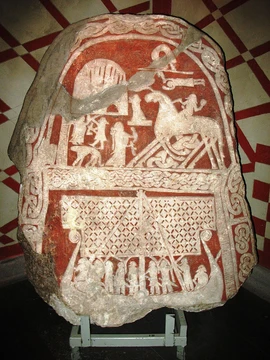
Baldr
Beloved god whose death foretold the doom of the gods.

Baldr (Old Norse; later Balder in Mainland Nordic, Baldur in Insular Nordic) is a god in Germanic mythology. In Norse mythology, he is a son of the god Odin and the goddess Frigg, and has numerous brothers, such as Thor and Váli. He is best known for his death, which is recounted as both a great tragedy to the Æsir and a harbinger of Ragnarök.
- Mythology
- Germanic (Norse)
- Parents
- Odin and Frigg
- Siblings
- Thor, Váli, Höðr, and others
- Spouse
- Nanna
- Children
- Forseti
- Known for
- His death and role as a harbinger of Ragnarök
- Hall
- Breidablik
Lore & Background
Baldr is described in the Prose Edda as the best of the Æsir, the most praised, and the wisest and most eloquent. He lives in Breidablik, a hall where no unclean thing may enter. His wife is Nanna, and their son is Forseti. Baldr had the greatest ship ever built, Hringhorni. According to Gylfaginning, Baldr had a dream of his own death, and his mother Frigg made every object on earth vow never to hurt him, except the mistletoe. Loki, the mischief-maker, fashioned a spear from mistletoe and tricked the blind god Höðr into throwing it at Baldr, killing him. Baldr was ceremonially burnt upon his ship Hringhorni, and his wife Nanna died of grief and was placed on the pyre. Odin whispered something in Baldr's ear as he was carried to the ship, the import of which remains unknowable.
Reader's Guide
Baldr's significance in Germanic mythology centers on his death, which is the first in a chain of events leading to Ragnarök. The story is attested in the Poetic Edda and the Prose Edda, compiled in Iceland during the 13th century but based on older Old Norse poetry. The Poetic Edda refers to his death in Völuspá, Lokasenna, and Baldr's Dreams, while the Prose Edda provides a full narrative. The Merseburg Incantation, a continental Germanic source, names Balder in a healing charm, though the identification is not conclusive. The name Baldr derives from Proto-Germanic *Balðraz ('Hero, Prince'), itself from *balþaz ('brave'), though Rudolf Simek notes this etymology suggests a warlike character not clearly supported by the myths. Early scholars interpreted Baldr as a light-god, linking the name to Indo-European bhel- ('white'), but this is debated. His legacy includes the prophecy that after Ragnarök, Höðr and Baldr will return, symbolizing a new age of peace.
Did You Know?
- Baldr's name is derived from Proto-Germanic *Balðraz, meaning 'Hero, Prince'.
- The only god who did not love Baldr was Loki, who ultimately killed him with trickery.
- Baldr's hall, Breidablik, is described as the most beautiful place, where no unclean thing may enter.
- After Ragnarök, according to Völuspá, Höðr and Baldr will come back, symbolizing a new age of peace.
The Name and Its Linguistic Heritage
The name Baldr carries a rich linguistic history stretching across the Germanic world. In Old Norse it appears as Baldr, later shifting to Balder in mainland Nordic and Baldur in insular traditions, while Old English renders it as Bældæġ and Old High German as Balder or Palter. Most scholars trace these forms back to Proto-Germanic *Balðraz, meaning 'Hero' or 'Prince,' itself built on the root *balþaz, 'brave.' Yet Rudolf Simek has pointed out a tension: this etymology implies a forceful, warlike temperament that the mythological sources do not clearly reflect. Early scholars, drawing on the Indo-European root bhel- for 'white,' read Baldr as a light-god, a reading consistent with Snorri's portrayal. In Old Norse the word also functioned as an honorific for heroes, and in Saxon and Anglo-Saxon tradition the name appears as Baldag or Bældæg, suggesting an association with 'day' itself.
Family, Kinship, and Divine Standing
Baldr occupies a central position within the Norse pantheon as the second son of Odin and Frigg, making Thor his elder brother. His sibling circle is broad, including the blind god Hödr and the avenger Váli, who was born at the very end of Baldr's life specifically to exact retribution for his death. Odin's prolific parentage meant Baldr had numerous other brothers as well. His domestic life is anchored by his wife Nanna, a goddess in her own right, and their sole child, Forseti. The sources lavish extraordinary prestige upon Baldr's material world: he commanded Hringhorni, described as the greatest ship ever built, and dwelt in Breidablik, a hall unmatched in beauty. Perhaps most striking is the near-universal affection he commanded. Both gods and mortals loved him, a sentiment that makes the singular exception of Loki all the more devastating. It was Loki, the one deity who did not share in this universal regard, who ultimately brought about Baldr's death through cunning and trickery, an act that shattered the harmony of the Æsir and set in motion the chain of events leading toward the twilight of the gods.
The Tragedy and Its Eschatological Weight
Across the Norse sources, Baldr's death functions as both the greatest sorrow of the Æsir and a portent of Ragnarök. In Völuspá, the Völva beholds 'the bleeding god' and narrates the killing, the birth of Váli to slay Höðr, and Frigg's grief. Yet the poem's final vision offers a glimmer of restoration: in stanza 62, the Völva gazes far into the future and sees Höðr and Baldr reunited, a union that scholars interpret as a symbol of the new age of peace following the world's renewal. The Lokasenna flyting sharpens the personal drama, with Frigg declaring that a son like Baldr would be Loki's undoing, and Loki coldly admitting he is the reason Baldr will never ride home again. The poem Baldr's Dreams deepens the mystery: the gods convene to discuss his troubling visions, and Odin, disguised as the wanderer Vegtam, rides to Hel and rouses a dead Völva. She reluctantly reveals that Höðr will be the killer, that Váli will avenge the death at merely one night old, and that women will weep in the aftermath. Each answer is followed by her insistence that she spoke unwillingly, underscoring the gravity of the prophecy.
Literary Attestations and the Question of Identity
The survival of Baldr's story depends on a scattered corpus of sources spanning several centuries and traditions. The earliest attestation may be one of the two Merseburg Incantations, which names Balder in the genitive and references a companion figure Phol, often identified as a byname for Baldr (appearing in Scandinavian as Falr or Fjalarr, and in Saxo as Balderus Fjallerus). The incantation describes Phol and Wotan riding to the woods where the foal's foot is sprained, with Sinthgunt, Frigg, and Odin singing a healing charm. Modern scholarship, however, questions whether Baldr is truly the intended deity, suggesting Freyr may be the more likely referent. In the twelfth century, Saxo Grammaticus and other Danish Latin chroniclers preserved a euhemerized retelling. The thirteenth-century Icelandic compilations—the Poetic Edda, drawing on older Old Norse verse, and Snorri Sturluson's Prose Edda—offer the most extensive treatment. Notably, the Poetic Edda refers to Baldr's death rather than narrating it at length, while Gylfaginning supplies genealogical details about Nanna and Forseti. Snorri himself bridges traditions, equating the Old English Beldeg with the Norse Baldr in the Eddic prologue.
Common Misconceptions (Editorial)
A common misconception is that Baldr is invulnerable by nature; in fact, he was made impervious to harm only through his mother Frigg extracting vows from every object not to hurt him, with the exception of mistletoe. Another error is that Loki himself threw the fatal projectile—actually Loki tricked the blind god Höðr into throwing the mistletoe spear that killed Baldr.
Why It Matters (Editorial)
Baldr endures as a symbol of innocence, light, and tragic loss in the Norse pantheon, his death serving as the catalyst for Ragnarök and the end of the old world. His promised return after the apocalypse, alongside his blind brother Höðr, offers a rare note of hope and reconciliation in a mythology otherwise defined by fate and strife.
Spotted an error? Know more?
This is a living reference — every entry is fact-audited, and reader corrections feed straight into our audit queue. Suggest an edit · See this site's audit record