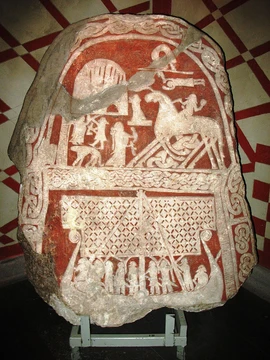
Freyja
Norse goddess of love, war, and seiðr, ruler of Fólkvangr.

Freyja (Old Norse '(the) Lady') is a goddess in Norse mythology associated with love, beauty, fertility, war, gold, and seiðr (magic for seeing and influencing the future). She is a member of the Vanir, along with her twin brother Freyr, her father Njörðr, and her mother (Njörðr's sister, unnamed in sources). Freyja is attested in the Poetic Edda, Prose Edda, Heimskringla, several Sagas of Icelanders, the short story 'Sörla þáttr', skaldic poetry, and modern Scandinavian folklore.
- Mythology
- Norse
- Known for
- Love, beauty, fertility, war, gold, seiðr
- Family
- Twin brother Freyr, father Njörðr, mother (unnamed sister of Njörðr), husband Óðr, daughters Hnoss and Gersemi
- Attributes
- Necklace Brísingamen, chariot pulled by two cats, boar Hildisvíni, cloak of falcon feathers
- Realm
- Fólkvangr (heavenly field) and hall Sessrúmnir
- Alternate names
- Gefn, Hörn, Mardöll, Sýr, Vanadís, Valfreyja
Lore & Background
Freyja is the owner of the necklace Brísingamen, rides a chariot pulled by two cats, is accompanied by the boar Hildisvíni, and possesses a cloak of falcon feathers to allow her to shift into falcon hamr. By her husband Óðr, she is the mother of two daughters, Hnoss and Gersemi. Freyja rules over her heavenly field, Fólkvangr, where she receives half of those who die in battle; the other half go to Odin's hall, Valhalla. Within Fólkvangr lies her hall, Sessrúmnir. Freyja assists other deities by allowing them to use her feathered cloak, is invoked in matters of fertility and love, and is frequently sought after by powerful jötnar who wish to make her their wife. Her husband Óðr is frequently absent; she cries tears of red gold for him and searches for him under assumed names.
Reader's Guide
Freyja is a central figure in Norse mythology, appearing in key poems such as Völuspá, Grímnismál, Lokasenna, Þrymskviða, Oddrúnargrátr, and Hyndluljóð. In Þrymskviða, she lends her cloak of feathers to Thor to help recover his hammer, Mjöllnir. In Hyndluljóð, she assists her servant Óttar by turning him into a boar and extracting genealogical information from the jötunn Hyndla. Scholars have debated whether Freyja and the goddess Frigg ultimately stem from a single goddess common among the Germanic peoples. They have connected her to the valkyries and analyzed her relation to other figures such as Gullveig/Heiðr, Gefjon, Skaði, and others. In Scandinavia, Freyja's name frequently appears in plant names, such as Freyja's tears and Freyja's hair (Polygala vulgaris), though these were renamed to honor the Virgin Mary during Christianization. Rural Scandinavians continued to acknowledge Freyja as a supernatural figure into the 19th century, and she has inspired various works of art.
Did You Know?
- Freyja's name transparently means 'lady, mistress' in Old Norse, stemming from Proto-Germanic *frawjōn.
- She receives half of those who die in battle in her field Fólkvangr; the other half go to Odin's Valhalla.
- Freyja cries tears of red gold for her frequently absent husband Óðr.
- Plants once named after Freyja, such as Freyja's hair, were renamed to honor the Virgin Mary during Christianization.
Divine Domains & Iconography
Freyja occupies a remarkably wide portfolio among the Norse pantheon. She is linked to love, beauty, and fertility, yet simultaneously to war, gold, and seiðr—the magic of seeing and shaping the future. This blend of tender and martial attributes sets her apart from many other goddesses. Her material iconography is equally distinctive: she owns the celebrated necklace Brísingamen, travels in a chariot drawn by two cats, is accompanied by the boar Hildisvíni, and carries a cloak of falcon feathers that enables her to assume a falcon's form. She belongs to the Vanir, the older divine family, alongside her twin brother Freyr and their father Njörðr. Her mother, Njörðr's sister, is never named in the surviving sources. Freyja's husband Óðr is perpetually absent, and she weeps red-gold tears for him while searching under assumed names. Their two daughters are Hnoss and Gersemi. Her many alternative names—Gefn, Hörn, Mardöll, Sýr, Vanadís, Valfreyja—reflect the breadth of her cultic identity.
Fólkvangr & the Battle-Slain
One of Freyja's most cosmologically significant roles is her governance of Fólkvangr, a heavenly field where she receives half of all warriors who fall in battle. The other half are allotted to Odin's hall, Valhalla, establishing a parallel system of divine reception for the slain. Within Fólkvangr stands her hall, Sessrúmnir, where she assigns seats to the dead each day. This division of the battle-dead between two supreme deities underscores Freyja's standing as a peer to Odin in matters of war and death. Beyond her own domain, she extends aid to other gods by lending them her feathered cloak, and she is specifically invoked in matters of fertility and love. She is also a persistent object of desire among powerful jötnar, who repeatedly seek to claim her as their wife—a motif that highlights both her beauty and her autonomy, since she is not simply a passive prize. Her role as a chooser of the slain connects her, in scholarly analysis, to the valkyries, the female figures who select which warriors fall and which are taken to the divine halls.
Narrative Appearances in the Eddas
Freyja's story is woven through several key poems of the Poetic Edda, a 13th-century compilation drawing on older oral tradition. In Völuspá, she is called "Óð's girl" and is said to have been once promised to an unnamed builder—later identified as a jötunn killed by Thor. In Grímnismál, Odin in disguise confirms to the young Agnar that Freyja allots seats daily to half the slain in Fólkvangr. The flyting poem Lokasenna features a heated exchange where Loki accuses her of sleeping with every god and elf in the hall; she retorts that he is a liar and a pervert, and Njörðr sides with her, noting that Loki himself has fathered children. In Þrymskviða, Loki borrows her falcon cloak to fly to Jötunheimr and discover that Þrymr has hidden Mjöllnir beneath the earth and demands Freyja as his bride. When Thor bluntly tells her to dress as a bride, she is so enraged that the halls shake and Brísingamen falls from her neck. These episodes reveal her as both a generous helper and a fierce, irascible figure.
Etymology, Scholarship & Cultural Afterlife
The name Freyja transparently means "lady" or "mistress" in Old Norse, deriving from the Proto-Germanic feminine noun *frawjōn, and is cognate with Old Saxon frūa and Old High German frouwa, the ancestor of modern German Frau. Scholars consider it an epithet that eventually replaced an older personal name now lost to history. It is also etymologically close to Freyr, meaning "lord." Academic debate continues over whether Freyja and Frigg ultimately descend from a single pre-Germanic goddess, and she has been linked to the thrice-burnt Gullveig/Heiðr, to Gefjon, Skaði, and others. In rural Scandinavia, her name persisted in plant nomenclature—Freyja's tears, Freyja's hair (Polygala vulgaris)—until Christianization replaced those names with references to the Virgin Mary. Yet rural Scandinavians continued to acknowledge her as a supernatural figure well into the 19th century, and she has inspired a wide range of artistic works from the medieval period to the present.
Common Misconceptions (Editorial)
- A common misconception is that Freyja is exclusively a goddess of love and beauty; in fact, she is also associated with war, gold, and seiðr, and she receives half of those who die in battle in her field Fólkvangr. - Some may assume Freyja’s tears of red gold for her husband Óðr signify a weak or purely romantic role, but these tears highlight her complex mythic identity tied to gold and loss. - It is often thought that all slain warriors go to Valhalla, but according to the facts, Freyja receives half of the battle-dead in Fólkvangr, with the other half going to Odin.
Why It Matters (Editorial)
Freyja endures as a symbol of the Norse understanding that love, war, and magic are not separate realms but interwoven forces governing life and death. Her continued presence in modern culture—from literature to neopagan practice—speaks to humanity’s lasting fascination with a goddess who embodies both tender desire and fierce sovereignty.
Spotted an error? Know more?
This is a living reference — every entry is fact-audited, and reader corrections feed straight into our audit queue. Suggest an edit · See this site's audit record