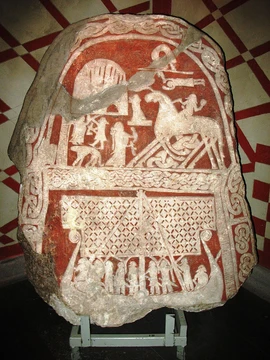
Frigg
Goddess of marriage, prophecy, and motherhood in Germanic myth.

Frigg is a goddess in Germanic mythology, one of the Æsir, and is most prominently attested in Norse mythology. She is associated with marriage, prophecy, clairvoyance, and motherhood, and dwells in the wetland halls of Fensalir. Nearly all sources portray her as the wife of the god Odin, and her name ultimately stems from the Proto-Germanic theonym *Frijjō.
- mythology
- Germanic (especially Norse)
- associated_with
- Marriage, prophecy, clairvoyance, motherhood
- spouse
- Odin
- children
- Baldr
- dwelling
- Fensalir
- weekday
- Friday (Frigg's Day)
Lore & Background
Frigg is the wife of Odin and mother of the gleaming god Baldr. She dwells in the wetland halls of Fensalir. In Old High German and Old Norse sources, she is specifically connected with Fulla, and her handmaiden Hlín attends her. The goddesses Lofn and Gná are listed among the Ásynjur, and Gná is explicitly described as a handmaiden of Frigg in the Prose Edda. Jörð is Odin's consort and mother of Thor, not his wife, and is not ambiguously connected to Frigg in the canon. The English weekday name Friday ultimately means 'Frigg's Day', derived from Old English Frīġedæġ.
Reader's Guide
Frigg appears in several key attestations. In the 7th-century Origo Gentis Langobardorum and Paul the Deacon's 8th-century Historia Langobardorum, she is called Frea and helps the Winnili (later the Langobards) by advising their women to arrange their hair like beards, tricking her husband Godan (Odin) into granting them victory. In the 10th-century Second Merseburg Incantation, she is invoked as Frija alongside Volla to heal a horse. In the Poetic Edda, she weeps for her son Baldr in Fensalir, wagers with Odin over the hospitality of King Geirröðr, and is referenced as Odin's beloved. After Christianization, mention of Frigg continued in Scandinavian folklore, and in modern times she appears in popular culture, art, and Germanic Neopagan veneration.
Did You Know?
- The name Frigg stems from Proto-Germanic *Frijjō, related to the Sanskrit priyā and Avestan fryā, meaning 'own, dear, beloved'.
- The English weekday name Friday derives from Old English Frīġedæġ, meaning 'day of Frig'.
- In the Origo Gentis Langobardorum, Frigg (as Frea) helps the Winnili by having their women arrange their hair like beards to trick Odin.
- The spelling Frigga is sometimes used by modern editors to distance the goddess from the English word frig.
Common Misconceptions (Editorial)
- Some people mistakenly think Frigg and the goddess Jörð are the same or connected in canon; however, Jörð is Odin's consort and mother of Thor, not his wife, and is not ambiguously connected to Frigg in the source material. - It is a common error to assume the weekday "Friday" refers to a generic "goddess of love" or other figure; the facts confirm it specifically means "Frigg's Day," derived from Old English Frīġedæġ. - The spelling "Frigga" is sometimes used by modern editors, but this is a deliberate alteration to distance the goddess from the modern English word "frig," not a historically accurate form.
Why It Matters (Editorial)
Frigg endures as a symbol of marriage, motherhood, and foresight, offering a counterpoint to the more warlike figures in Norse mythology. Her name lives on every Friday, reminding modern speakers of the deep linguistic and cultural roots Germanic goddesses still hold in daily life.
Spotted an error? Know more?
This is a living reference — every entry is fact-audited, and reader corrections feed straight into our audit queue. Suggest an edit · See this site's audit record