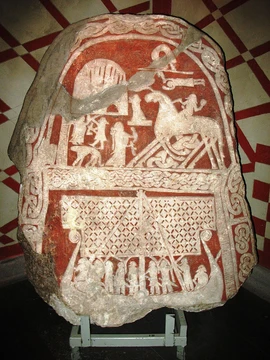
Hel
Norse being who rules the underworld realm of the same name.

Hel (Old Norse) is a female being in Norse mythology who presides over an underworld realm of the same name, where she receives a portion of the dead. She is attested in the Poetic Edda and Prose Edda, both compiled in the 13th century from earlier traditional sources, as well as in poems recorded in Heimskringla and Egils saga dating from the 9th and 10th centuries. An episode in the Latin work Gesta Danorum, written in the 12th century by Saxo Grammaticus, is generally considered to refer to Hel, and she may appear on various Migration Period bracteates.
- Mythology
- Norse
- Attested in
- Poetic Edda, Prose Edda, Heimskringla, Egils saga, Gesta Danorum
- Known for
- Ruler of the underworld realm Hel, daughter of Loki
- Appearance
- Half blue and half flesh-coloured, gloomy and downcast
- Realm
- Niflheim, with vast mansions and servants
Lore & Background
In the Prose Edda book Gylfaginning, Hel is described as a daughter of Loki and the giantess Angrboða, and as a sibling of the wolf Fenrir and the serpent Jörmungandr. The god Odin appointed Hel as ruler of a realm located in Niflheim, bestowing upon her authority over nine worlds, where she administers board and lodging to those who die of sickness or old age. Her appearance is described as half black and half flesh-coloured, and she is said to be rather downcast and fierce-looking. Hel rules over great mansions with extremely high walls and immense gates, including a hall called Éljúðnir, a dish called Hunger, a knife called Famine, and servants named Ganglati and Ganglöt.
Reader's Guide
Hel plays a key role in the attempted resurrection of the god Baldr, as recounted in the Prose Edda. After Baldr's death, the god Hermóðr rides to Hel's hall to beg for his return. Hel agrees to release Baldr if all things in the world, alive or dead, weep for him; when the female jötunn Þökk refuses, Baldr remains with Hel. Scholarly theories have proposed potential connections between Hel and figures in the 11th-century Old English Gospel of Nicodemus and Old Norse Bartholomeus saga postola, and that she may have been considered a goddess with possible Indo-European parallels in Bhavani, Kali, and Mahakali. Alternatively, Hel may have become a being only as a late personification of the location of the same name. The name Hel stems from the Proto-Germanic feminine noun *haljō- meaning 'concealed place, the underworld', ultimately deriving from the Proto-Indo-European verbal root *ḱel- 'to conceal, cover, protect'.
Did You Know?
- Hel is referred to as a daughter of Loki in the Poetic Edda, Prose Edda, and Heimskringla.
- The Old Norse name Hel is identical to the name of the location over which she rules.
- Hel's appearance is described as half blue and half flesh-coloured in the Prose Edda.
- Hel may appear on various Migration Period bracteates.
Identity, Parentage & Appearance
Hel is identified across the Poetic Edda, Prose Edda, and Heimskringla as the daughter of Loki. In Gylfaginning, she is one of three offspring Loki sired with Angrboða, alongside the wolf Fenrir and the serpent Jörmungandr. When the gods foresaw great disaster from these siblings, Odin personally intervened, casting Hel into Niflheim and granting her dominion over nine worlds. Her physical description is striking: half black or blue and half flesh-coloured, making her immediately recognizable. She is further characterized as downcast and fierce-looking, a gloomy presence befitting her domain. She is not merely a passive figure of death but an active ruler who presides over vast mansions and administers board and lodging to those who die of sickness or old age. In the Poetic Edda, Völuspá references her halls, while Grímnismál places her dwelling beneath one of the three roots of Yggdrasil, the world tree, anchoring her within the cosmic architecture.
The Realm of Hel
Hel's domain, situated in Niflheim, is rendered in Gylfaginning with remarkable specificity. The realm features great mansions with extremely high walls and immense gates. Within stands a hall called Éljúðnir, accompanied by a dish named Hunger and a knife named Famine. Her household includes servants Ganglati and Ganglöt, both whose names translate as "lazy walker," while the entrance threshold is called Stumbling-block, the bed Sick-bed, and the curtains Gleaming-bale. The realm is specifically designated for those who die of sickness or old age, setting it apart from other fates of death. In Fáfnismál, the hero Sigurd declares that the slain dragon Fáfnir lies in pieces where "Hel can take" him, while Atlamál uses the phrases "Hel has half of us" and "sent off to Hel" as expressions of mortality. Hamðismál may allude to her as the "troll-woman" or "ogress" in connection with death, though some scholars suggest this could reference an unspecified dís rather than Hel herself.
The Baldr Episode & Hel's Authority
One of Hel's most narratively significant roles appears in chapter 49 of Gylfaginning, where she is central to the aftermath of the god Baldr's death. Frigg, grieving, asks which of the Æsir will earn her full love and favour by riding to Hel to seek a ransom for Baldr's return. The god Hermóðr volunteers and departs on the eight-legged horse Sleipnir. Upon arriving in Hel's hall, Hermóðr finds his brother Baldr there and spends the night. The following morning, he begs Hel to release Baldr so he may ride home. This episode positions Hel not as a mere abstract concept of death but as a powerful authority figure whose permission is required for the return of even a deity. The Poetic Edda's Baldrs draumar reinforces this gravity, depicting Odin himself riding toward the "high hall of Hel." The Prose Edda further notes that Hel plays a key role in the attempted resurrection, making her one of the few underworld figures in Norse myth to be directly addressed and negotiated with by the gods.
Etymology & Scholarly Speculation
The name Hel traces back through Proto-Germanic *haljō-, meaning "concealed place" or "the underworld," itself derived from *helan-, "to cover, conceal, hide," which in turn descends from the Proto-Indo-European root *ḱel-, "to conceal, cover, protect." This same root yields Latin cēlō, Greek kalúptō, and Old Irish ceilid. Related Germanic compounds include *halja-rūnō(n), producing Old English "helle-rúne" (a possessed woman or sorceress) and Old High German "helli-rūna" (magic), and *halja-wītjan, giving Old English "helle-wíte" (hell-torment) and Old Norse "hel-víti." Distantly, Hel connects to Valhöll and the English word "hall" via the same PIE root. Scholars have also proposed that Hel may have been regarded as a goddess with Indo-European parallels in figures such as Bhavani, Kali, and Mahakali, or alternatively that she emerged only as a late personification of the place bearing her name. She may also appear on Migration Period bracteates.
Common Misconceptions (Editorial)
Some mistakenly believe Hel is a male figure or purely a place, but the facts confirm Hel is a female being who rules an underworld realm of the same name. Others assume she presides over all dead, but she specifically administers to those who die of sickness or old age. A common misconception describes her appearance as entirely blue, whereas the Prose Edda states she is half blue and half flesh-coloured.
Why It Matters (Editorial)
Hel endures as a compelling figure because she embodies the Norse understanding of death as a natural, orderly domain rather than a punishment. Her role as a ruler of a specific portion of the dead—not all souls—reflects a nuanced worldview that continues to fascinate modern audiences through literature, art, and popular culture.
More in Norse Myths 1-22
Spotted an error? Know more?
This is a living reference — every entry is fact-audited, and reader corrections feed straight into our audit queue. Suggest an edit · See this site's audit record