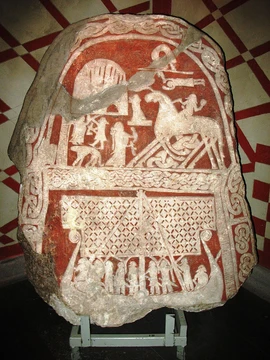
Fenrir
Monstrous wolf foretold to kill Odin at Ragnarök.

Fenrir (Old Norse 'fen-dweller'), also known as Fenrisúlfr, Hróðvitnir, and Vánagandr, is a monstrous wolf in Norse mythology. He is a child of Loki and the female jötunn Angrboða, and is attested in the Poetic Edda, Prose Edda, and Heimskringla. Fenrir is foretold to play a key role during Ragnarök, where he will set the world aflame, cause the collapse of humanity and society, and kill the god Odin.
- Mythology
- Norse
- Parents
- Loki and Angrboða
- Siblings
- Hel and Jörmungandr
- Offspring
- Sköll and Hati Hróðvitnisson
- Known for
- Killing Odin at Ragnarök; biting off Týr's right hand
- Fate
- Killed by Odin's son Víðarr
Lore & Background
Fenrir is a son of Loki and the female jötunn Angrboða, and sibling to Hel and Jörmungandr. In Old Norse texts, he is the father of the wolves Sköll and Hati Hróðvitnisson. Due to prophecies foretelling great trouble from Fenrir and his rapid growth, the gods bound him. They first used fetters called Leyding and Dromi, which Fenrir broke. The dwarves then made a fetter called Gleipnir from six mythical ingredients, which appeared as a silken ribbon but was unbreakable. When the gods attempted to bind him with Gleipnir, Fenrir demanded a pledge of good faith: that one of the gods place a hand in his mouth. Týr alone volunteered, and when the gods refused to release Fenrir, the wolf bit off Týr's right hand at the wrist, a location 'now called the wolf-joint.' The gods then fastened Fenrir with a cord called Gelgja through a stone slab called Gjöll, and anchored it with a rock called Thviti, thrusting a sword into his mouth to keep his jaws open.
Reader's Guide
Fenrir's significance in Norse mythology centers on his role in Ragnarök, where he is foretold to assist in setting the world aflame, resulting in the collapse of humanity and society, and killing the god Odin. His death comes at the hands of Odin's son Víðarr, who avenges his father. The story of Fenrir's binding illustrates the gods' attempts to avert prophecy and the cost of deception, as Týr loses his hand. Fenrir is attested in the Poetic Edda, compiled in the 13th century from earlier traditional sources, and the Prose Edda and Heimskringla, composed in the 13th century. Depictions of Fenrir have been identified on various objects, and scholarly theories have been proposed regarding his relation to other canine beings in Norse mythology. He has been the subject of artistic depictions and appears in literature.
Did You Know?
- Fenrir is also referred to as Hróðvitnir (Old Norse 'fame-wolf') and Vánagandr (Old Norse 'monster of the [River] Ván').
- Fenrir bit off the right hand of the god Týr when the gods bound him with the fetter Gleipnir.
- Fenrir is the father of the wolves Sköll and Hati Hróðvitnisson.
- Fenrir will be killed by Odin's son Víðarr during Ragnarök.
Origins, Names, and Family
Fenrir carries a constellation of names that reveal different facets of his mythic identity. The most common, Fenrir, derives from Old Norse meaning "fen-dweller," while Fenrisúlfr translates more literally as "Fenrir's wolf" or "Fenris-wolf." He is also called Hróðvitnir, "fame-wolf," and Vánagandr, "monster of the River Ván." His parentage places him among the most dangerous beings in the Norse pantheon: he is the offspring of the trickster god Loki and the female jötunn Angrboða. His siblings are the world-serpent Jörmungandr and the death-ruler Hel, and together the three were foretold to bring catastrophic mischief upon the gods. Unlike his siblings, who were cast into the sea and Niflheim respectively, Fenrir was raised among the Æsir at their own home. Only the god Týr possessed the courage to approach the growing beast and feed him. Fenrir also sired two wolves of his own, Sköll and Hati Hróðvitnisson, extending his lineage into the celestial realm.
The Binding and Týr's Sacrifice
The Æsir, aware of prophecies predicting enormous harm from the wolf, devised a plan to restrain him. They first presented Fenrir with a fetter called Leyding, described as greatly strong. The wolf tested it and snapped it with a single kick. Undeterred, the gods forged a second chain, Dromi, twice as powerful. Fenrir, eager for the fame that breaking such a feat of engineering would bring, allowed himself to be bound. When the gods declared readiness, he shook free, struck the ground, strained with full force, and kicked the chain apart into fragments that flew far into the distance. These incidents gave rise to enduring sayings: to "loose from Leyding" or to "strike out of Dromi" meant accomplishing something through tremendous effort. Fearing they could not bind him, Odin dispatched Freyr's messenger Skírnir to the dwarves of Svartálfaheimr, who crafted Gleipnir from six mythical ingredients. At Fenrir's own request, Týr placed his hand inside the wolf's jaws as a guarantee of release. When the Æsir refused to unbind him, Fenrir bit off Týr's hand at the wrist—a joint still called the "wolf-joint"—leaving the god permanently one-handed and no longer regarded as a fair mediator among people.
Ragnarök and the Death of Odin
In the eschatological vision of Völuspá, the völva foretells that Fenrir will play a central role in the destruction of the world. He is destined to consume Odin, the Allfather, during the cataclysmic events of Ragnarök, an act that will help set the world aflame and bring about the collapse of humanity and all society. The same poem also reveals that in the eastern forest of Járnviðr, an old woman bred the broods of Fenrir, from which one descendant would become a "moon-snatcher in troll's skin." In Vafþrúðnismál, the wise jötunn Vafþrúðnir confirms that the sun goddess Sól will bear a daughter before Fenrir attacks her, and that this daughter will carry on her mother's course across the heavens. Yet Fenrir's triumph is not final. In the stanza following Odin's death, the völva describes how Odin's son Víðarr—called the "tall child of Triumph's Sire"—will avenge his father by driving a sword into the heart of the "beast of slaughter," the "son of Hveðrungr." This mutual killing defines Fenrir's place in the mythic cycle: he is both the destroyer of the old order and the one felled by its heir.
Attestations and Cultural Resonance
Fenrir's story survives through a constellation of medieval sources. The Poetic Edda, compiled in the thirteenth century from older oral traditions, mentions him in three stanzas of Völuspá, two in Vafþrúðnismál, and in the flyting poem Lokasenna, where Loki taunts Týr about losing his hand to the wolf and Týr retorts with a pointed reference to the binding. The Prose Edda, also a thirteenth-century work, spreads Fenrir's narrative across three books—Gylfaginning, Skáldskaparmál, and Háttatal—with Gylfaginning providing the most detailed prose account of his upbringing, the three fetters, and Týr's sacrifice. Heimskringla, another thirteenth-century composition, also attests to the wolf. Beyond the written word, depictions of Fenrir have been identified on various archaeological objects, and scholars have proposed theories connecting him to other canine beings within the Norse mythological framework. His enduring presence in artistic depictions and modern literature testifies to the lasting power of a figure who embodies both the terror of the unbound and the tragic cost of broken trust.
Common Misconceptions (Editorial)
Some believe Fenrir was bound merely by a magical ribbon, but the facts show the gods first attempted two other fetters, Leyding and Dromi, which Fenrir broke before the dwarves forged Gleipnir. Others assume all of Loki's monstrous children were serpents or giants, but Fenrir is specifically attested as a wolf, and he is the father of two wolves, Sköll and Hati Hróðvitnisson. It is also a misconception that Fenrir killed Odin and survived Ragnarök; the facts state he will be killed by Odin's son Víðarr.
Why It Matters (Editorial)
Fenrir endures as a symbol of uncontrollable destructive forces that even the gods cannot contain without sacrifice. His story illustrates the Norse emphasis on fate and the cost of trying to avert prophecy, as the gods' own binding of Fenrir sets in motion the chain of events leading to Odin's death and Ragnarök.
Spotted an error? Know more?
This is a living reference — every entry is fact-audited, and reader corrections feed straight into our audit queue. Suggest an edit · See this site's audit record