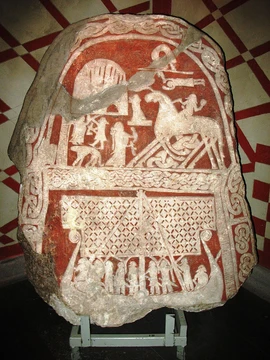
Thor
Hammer-wielding thunder god of Germanic paganism.

Thor (from Old Norse: Þórr) is a prominent god in Germanic paganism, associated with thunder, storms, strength, protection, fertility, and farmers. He is a hammer-wielding deity whose name appears across Germanic languages, including Old English Thunor, Old Saxon Thunar, and Old High German Donar, all stemming from the Proto-Germanic theonym *Þun(a)raz, meaning 'Thunder'. Thor is widely attested from the Roman occupation of Germania through the Viking Age, when his hammer Mjölnir was worn as an emblem and his name featured in personal names.
- Pantheon
- Germanic paganism
- Associated with
- Thunder, storms, strength, protection, fertility, farmers
- Symbols
- Hammer Mjölnir, belt Megingjörð, iron gloves Járngreipr, staff Gríðarvölr
- Consorts
- Sif (wife), Járnsaxa (lover)
- Offspring
- Þrúðr (with Sif), Magni (with Járnsaxa), Móði (mother unnamed)
- Parents
- Odin and Jörð
- Day of week
- Thursday (from Old English Þunresdæg)
Lore & Background
Thor is the son of Odin and Jörð, and through Odin he has numerous brothers, including Baldr. He is the husband of the golden-haired goddess Sif and the lover of the jötunn Járnsaxa. With Sif he fathered Þrúðr; with Járnsaxa, Magni; and with an unnamed mother, Móði. He is also the stepfather of the god Ullr. Thor has two servants, Þjálfi and Röskva, and rides a cart or chariot pulled by two goats, Tanngrisnir and Tanngnjóstr, which he eats and resurrects. He is ascribed three dwellings: Bilskirnir, Þrúðheimr, and Þrúðvangr. Thor wields the hammer Mjölnir, wears the belt Megingjörð and iron gloves Járngreipr, and owns the staff Gríðarvölr.
Reader's Guide
Thor's significance spans from the Roman era to modern times. During the Roman period, Tacitus identified Thor with Hercules, likely due to similarities between Thor's hammer and Hercules' club. In the Migration Period, the Nordendorf fibulae bear the name Þonar (Donar). The Old Saxon Baptismal Vow records Thunaer among gods renounced during Christianization. In the Viking Age, personal names containing Þórr flourished, possibly as a defiant response to Christianization, alongside widespread wearing of Thor's hammer pendants. Thor's narratives are most prominently attested in Old Norse mythology, including his fierce battles with the serpent Jörmungandr and their foretold mutual deaths at Ragnarök. The weekday Thursday derives from Old English Þunresdæg ('Thunor's day'), a calque of Latin Iovis dies. Into the modern period, Thor appears in folklore, place names, and revived veneration in Heathenry.
Did You Know?
- Thor's name derives from Proto-Germanic *Þun(a)raz, meaning 'Thunder'.
- The weekday Thursday comes from Old English Þunresdæg, 'Thunor's day'.
- In Tacitus's Germania, the chief god of the Germanic tribes is identified as Hercules, not Thor; Tacitus does not explicitly name Thor or compare his hammer to a club.
- Thor's hammer Mjölnir was worn as an emblem during the Viking Age, often as a defiant response to Christianization.
The 19th-Century Rediscovery and European Literary Influence
Norse mythology, preserved in ancient Icelandic texts such as the Poetic Edda and the Prose Edda, remained largely confined to Scandinavia until the 19th-century Viking revival brought it to wider attention. Antiquaries like George Webbe Dasent reintroduced Scandinavian myth to audiences in Germany and England, where it was recognized as the latest surviving expression of Germanic paganism—a tradition those nations had lost through earlier Christianization. In Britain, William Morris composed poetry on Norse legendary subjects and translated Icelandic sagas into English. In Germany, Richard Wagner drew on Norse characters and themes for his four-opera cycle Der Ring des Nibelungen, though he also incorporated medieval German sources and Germanized the gods' names. The rediscovery in Germany also transformed the art-religious context of the myths into an alternative spiritual practice. J.R.R. Tolkien's The Lord of the Rings was said to carry heavy Norse mythological influence, sparking ongoing debates about structural and theoretical approaches to mythology.
Thor and the Norse Pantheon in American Comics
In the Marvel Universe, Thor stands as one of the company's longest-running superheroes, holding starring roles in both The Avengers comics and the Marvel Cinematic Universe. His adopted brother Loki serves as one of the most prominent villains in that franchise, functioning as a main antagonist across the MCU. The broader Norse pantheon permeates Marvel's world: Odin, Freyja, Brunnhilde/Valkyrie and the Valkyrior, Heimdall, Hela, Balder, Sif, and Fenrir all appear as characters. Beyond Marvel, Neil Gaiman's Sandman graphic novel series gives recurring roles to Odin, Thor, Loki, and other Norse beings, most notably in the Season of Mists and The Kindly Ones story arcs. The spinoff series Lucifer continues this tradition, featuring Loki and Sigyn in brief appearances while giving prominent roles to Bergelmir, Yggdrasil, and Naglfar, with Fenrir as a major antagonist. Additional American works include Erik Evensen's Gods of Asgard, which received a Xeric grant in 2007, and the 2001 miniseries Hammer of the Gods by Michael Avon Oeming and Mark Wheatley.
Norse Mythology in Japanese and Korean Media
Norse mythology has left a deep imprint on Japanese and Korean visual storytelling. The manga and anime Matantei Loki Ragnarok, loosely translated as The Mythical Detective Loki Ragnarok, places Norse Pantheon heroes at its center. In South Korea, Myung-Jin Lee's manhwa series Ragnarok is built around the prophesied fall of the gods. Vinland Saga, set in Iceland and 11th-century Europe, weaves numerous references to Norse myth into its narrative. Attack on Titan carries prominent Norse themes: Ymir, Castle Utgard, the walls, and plot parallels between the Aesir-Vanir wars and the Titan shifter conflict, alongside smaller details like Norse runes on a herring can and a giant boar in the second OVA. Sword Art Online features characters and storylines drawn from Norse mythology. In the High School DxD light novel and anime, Norse mythology forms one of the supernatural factions: Odin aids the Occult Research Club in Volume 6, while Loki attempts to trigger Ragnarok in Volume 7 with his son Fenrir. Jormundgandr ranks among the Five Great Dragon Kings, and Valkyries like Rossweisse and Gondul play significant roles.
Storytelling as the Engine of Mythic Transmission
Norse mythology's survival and global reach depend fundamentally on the act of storytelling. The original myths were preserved in ancient Icelandic texts—the Poetic Edda, the Prose Edda, and various lays and sagas—and for centuries they remained largely unknown beyond Scandinavia. The 19th-century Viking revival, with its widespread publication of Norse myths and legends, re-ignited this storytelling tradition across European literary culture in Scandinavia, Germany, and Britain. In the later 20th century, the same narrative impulse carried Norse mythology into science fiction, fantasy literature, role-playing games, and eventually Japanese animation. Each new retelling—whether a comic book, an opera, a manga series, or a graphic novel—recontextualizes the myths for a new audience while preserving their core dramatic structures. The cycle is self-reinforcing: the rediscovery of the myth in one era fuels new storytelling in the next, ensuring that figures like Thor, Loki, and Odin continue to find fresh expression in ever-expanding cultural products.
Common Misconceptions (Editorial)
- Some people think Thor's hammer was always depicted as a modern fantasy-style war hammer, but the facts note only that Mjölnir was a hammer emblem worn during the Viking Age, without specifying a shape. - A common misconception is that Tacitus explicitly named Thor as the chief Germanic god, but the facts clarify Tacitus identified the chief god as Hercules and did not name Thor or compare his hammer to a club. - It is often assumed that Thor is exclusively a Norse figure, but the facts show his name appears across Old English, Old Saxon, and Old High German, indicating worship throughout Germanic paganism, not just Scandinavia.
Why It Matters (Editorial)
Thor endures as a symbol of raw power and protection, reflecting humanity's timeless need to personify nature's most formidable forces. His name lives on in the weekday Thursday, linking ancient belief to modern daily life, while his hammer Mjölnir continues to resonate as an emblem of defiance and cultural identity.
More in Norse Myths 1-22
Spotted an error? Know more?
This is a living reference — every entry is fact-audited, and reader corrections feed straight into our audit queue. Suggest an edit · See this site's audit record