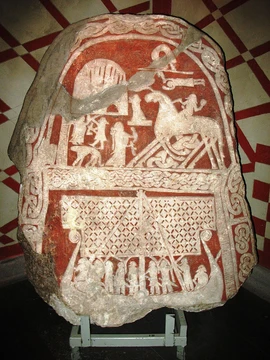
Odin
Widely revered Norse god of war, death, and wisdom.

Odin is a widely revered god in Norse mythology and Germanic paganism, with an attested history spanning over a thousand years. Most surviving information on Odin comes from Norse mythology, but he figures prominently in the recorded history of Northern Europe, including the Roman Empire's partial occupation of Germania, the Migration Period, and the Viking Age.
- field
- Norse mythology and Germanic paganism
- known_for
- God of the dead and warfare; head of the pantheon; associated with poetry, wisdom, and the Wild Hunt
- associated_deities
- Frigg (wife), Thor (son), Baldr (son), Vili and Vé (brothers)
- mythological_roles
- Leader of the einherjar at Valhöll; slain by Fenrir at Ragnarök
Lore & Background
Odin is depicted in the 13th-century Prose Edda and the Poetic Edda as the head of the pantheon, sometimes called the Æsir, bearing a spear and a ring. He is the son of Bestla and Borr, brother to Vili and Vé, and husband to the goddess Frigg, with whom he fathered Baldr. He also fathered Thor with the earth-goddess Jörð. Odin is often described as long-bearded, an old man, and possessing only one eye, having sacrificed the other for wisdom. He is sometimes accompanied by animal familiars, including the ravens Huginn and Muninn and the wolves Geri and Freki. The Prose Edda describes Odin and his brothers creating the world by slaying the primordial being Ymir and giving life to the first humans Ask and Embla.
Reader's Guide
Odin is widely regarded as a god of the dead and warfare, receiving slain warriors—the einherjar—at Valhöll in Asgard. The Poetic Edda associates him with Valkyries, perhaps as their leader. In the mythic future, Odin leads the einherjar at Ragnarök, where he is killed by the monstrous wolf Fenrir. Accounts by early travellers to Northern Europe describe human sacrifices being made to Odin. In Old English texts, he is euhemerized as an ancestral figure for royalty and frequently depicted as a founding figure for various Germanic peoples, such as the Langobards. In some later folklore, he is a leader of the Wild Hunt, a ghostly procession of the dead. Odin has hundreds of names and titles, several stemming from the reconstructed Proto-Germanic theonym Wōðanaz, meaning 'lord of frenzy' or 'leader of the possessed', which may relate to the god's strong association with poetry. The modern English weekday name Wednesday derives from Old English Wōdnesdæg, meaning 'day of Wōden'. In modern times, most forms of the new religious movement Heathenry venerate him; in some, he is the central deity. The god regularly features across all forms of modern media, especially genre fiction.
Did You Know?
- The modern English weekday name Wednesday derives from Old English Wōdnesdæg, meaning 'day of Wōden'.
- Odin sacrificed one of his eyes for wisdom.
- In the mythic future, Odin is killed by the monstrous wolf Fenrir at Ragnarök.
The Architecture of the Cosmos
Norse mythology envisions a universe organized around a central sacred tree called Yggdrasil, flanked by Nine Worlds. This cosmological structure is not static; it is bound to a cyclical narrative of creation, destruction, and renewal. The world itself is fashioned from the body of the primordial being Ymir, and the first humans, Ask and Embla, are created to inhabit it. Time and natural elements are not abstract forces but personified as deities or beings within this framework. The entire order is ultimately destined for Ragnarök, an immense battle between the gods and their enemies that engulfs the world in fire. Yet destruction is not the final word: after the flames subside, the land is reborn fertile and green, the surviving gods gather, and two humans repopulate the world. This cycle of annihilation and regeneration gives the mythology a profound sense of cosmic rhythm, where even the gods are subject to a fate beyond their own power.
The Manuscript Tradition and Its Makers
The surviving body of Norse mythological text was almost entirely preserved in Iceland during the thirteenth century, when oral traditions inherited from pre-Christian inhabitants were transcribed into written manuscripts. Two collections stand at the core: the Prose Edda, authored by the Icelandic scholar, lawspeaker, and historian Snorri Sturluson, and the Poetic Edda, an anonymous compilation of older verse. The Prose Edda was designed as a practical manual for composing skaldic poetry, a tradition of alliterative verse rich in kennings and varied metrical patterns. The Poetic Edda, by contrast, is predominantly verse with minimal prose narrative, employing a plainer style with fewer ornamental kennings. Both texts carry layers of euhemerization, a technique that recasts gods as once-mortal magic-wielders or reinterprets them through a Christian lens. Additional works such as Snorri's Heimskringla and Saxo Grammaticus's twelfth-century Gesta Danorum reflect even heavier euhemeristic treatment. Together, these manuscripts represent only a small fraction of the mythical poems and tales that once circulated across the Viking Age and earlier periods.
The Divine Drama and Its Cast
At the heart of Norse mythology lies the ongoing struggle and interplay among the gods, the jötnar, and humanity. The jötnar are not simply villains; they occupy a spectrum of relationships with the divine, serving as friends, lovers, adversaries, or even family members. Among the pantheon, the thunder-god Thor, the raven-flanked Odin, and the goddess Freyja are prominently named, alongside numerous other deities. Beings such as valkyries and dísir, associated with war, fate, and ancestor cults, further populate the mythological landscape. The narratives center on the plights of the gods and their interactions with these various beings, creating a dramatic web of alliances and conflicts. Archaeological evidence, including amulets depicting Thor's hammer Mjölnir found in pagan burials and small silver female figures possibly representing valkyries or dísir, confirms that these figures held tangible significance in the daily spiritual lives of the North Germanic peoples. The mythology thus presents a cosmos where divinity is not monolithic but a complex, relational network of powers.
From Scholarly Revival to Modern Resonance
Norse mythology entered the orbit of European intellectual life in the seventeenth century, when key texts first attracted the attention of scholarly circles. Through comparative mythology and historical linguistics, researchers have traced elements of the tradition back to Proto-Indo-European mythology, while also drawing parallels with other attested Germanic branches such as the Old High German Merseburg Incantations. The Romanticist Viking revival of the modern period rekindled widespread public fascination, and references to Norse mythological figures now permeate popular culture across the globe. Beyond academic and artistic spheres, the myths have experienced a religious revival among adherents of Germanic Neopaganism, who practice within a living spiritual framework. Traces of the old faith persist in place names that bear the names of gods, in runic inscriptions on stones and amulets, and in later medieval and early modern sources such as the seventeenth-century Icelandic Galdrabók grimoire and a fourteenth-century Norwegian charm. These scattered remnants testify to a tradition that, though largely unrecorded, once shaped the worldview of an entire people.
Common Misconceptions (Editorial)
A common misconception is that Odin is a purely fictional character invented for Viking-era stories, but the facts show he has an attested history spanning over a thousand years and appears in records from the Roman Empire’s occupation of Germania through the Migration Period. Another misconception is that Odin is primarily a benevolent or wise king figure; in reality, the record identifies him as a god of the dead and warfare, and his pursuit of wisdom involved sacrificing his own eye.
Why It Matters (Editorial)
Odin endures because he embodies a primal human fascination with sacrifice for knowledge and the acceptance of inevitable doom—he gives up an eye for wisdom and is prophesied to be slain at Ragnarök, yet he still prepares for it. His influence persists in everyday language, as seen in the weekday Wednesday, which keeps his presence alive in modern culture long after the original myths were written down.
More in Norse Myths 1-22
Spotted an error? Know more?
This is a living reference — every entry is fact-audited, and reader corrections feed straight into our audit queue. Suggest an edit · See this site's audit record