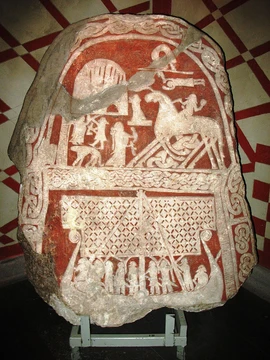
Valhalla
Hall of the slain, ruled by Odin in Norse mythology.

Valhalla is a majestic hall located in Asgard and presided over by the god Odin in Norse mythology. It is described as the fifth and final realm the soul could travel to after death, serving as a hall for fallen heroes killed in combat, known as the einherjar, along with various legendary Germanic heroes and kings.
- realm
- Asgard
- ruler
- Odin
- inhabitants
- Einherjar (slain warriors), legendary Germanic heroes and kings
- purpose
- Hall of the slain, where warriors prepare for Ragnarök
- attested_in
- Poetic Edda, Prose Edda, Heimskringla, Eiríksmál
- etymology
- Old Norse Valhǫll, originally 'rock of the slain'
Lore & Background
Valhalla is attested in the Poetic Edda, compiled in the 13th century from earlier traditional sources, in the Prose Edda (written in the 13th century by Snorri Sturluson), in Heimskringla (also written in the 13th century by Snorri Sturluson), and in stanzas of an anonymous 10th-century poem commemorating the death of Eric Bloodaxe known as Eiríksmál as compiled in Fagrskinna. In the Poetic Edda poem Grímnismál, Odin describes Valhalla as shining and golden, with spear-shafts for rafters, a roof thatched with shields, coats of mail strewn over its benches, a wolf hanging in front of its west doors, and an eagle hovering above it. The poem Helgakviða Hundingsbana II describes the hero Helgi Hundingsbane dying and going to Valhalla, where he manages things with Odin and has his former enemy Hunding perform menial tasks.
Reader's Guide
Valhalla was idealized in Viking culture and gave the Scandinavians a widespread cultural belief that there is nothing more glorious than death in battle. The belief in a Viking paradise and eternal life in Valhalla with Odin may have given the Vikings a violent edge over other raiders of their time period. The masses of those killed in combat (the einherjar) live in Valhalla until Ragnarök, when they will march out of its many doors to fight in aid of Odin against the jötnar. Valhalla has inspired innumerable works of art, publication titles, and elements of popular culture and is synonymous with a martial hall of the chosen dead. The name is rendered in modern Scandinavian languages as Valhöll in Icelandic, Valhall in Swedish and Norwegian, Valhøll in Faroese, and Valhal in Danish.
Did You Know?
- The Modern English noun Valhalla derives from Old Norse Valhǫll, originally meaning 'rock of the slain'.
- In Swedish folklore, some mountains traditionally regarded as abodes of the dead were also called Valhall.
- Valhalla is one of five possible realms the soul could travel to after death, alongside Fólkvangr, Hel, the realm of Rán, and the Burial Mound.
- The second element hǫll is cognate to Modern English hall and developed from Proto-Germanic *xallō or *hallō.
Common Misconceptions (Editorial)
One common misconception is that Valhalla is the only or primary afterlife destination for all who die in battle. In fact, Valhalla is just one of five possible realms the soul could travel to after death, alongside Fólkvangr, Hel, the realm of Rán, and the Burial Mound. Another misconception is that Valhalla was simply a peaceful paradise for fallen warriors; in reality, the einherjar there were preparing for Ragnarök, and the hall is described with harsh martial imagery like spear-shafts for rafters and a roof thatched with shields.
Why It Matters (Editorial)
Valhalla endures because it represents a culture’s attempt to give meaning and honor to violent death, transforming warriors into heroes who will fight again at the end of the world. Its golden halls and eternal battle echo universal human desires for glory, purpose, and belonging even after life, which is why the name still feels powerful in modern stories and games.
Spotted an error? Know more?
This is a living reference — every entry is fact-audited, and reader corrections feed straight into our audit queue. Suggest an edit · See this site's audit record