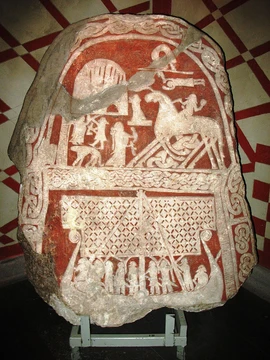
The Aesir
Gods of Germanic paganism, central to Old Norse mythology.

The Æsir (Old Norse; singular: áss, female: ásynja) are gods in Germanic paganism. In Old Nordic religion and mythology, the precise meaning of the term is debated, as it can refer either to the gods in general or specifically to one of the main families of gods, in contrast to the Vanir, with whom the Æsir waged war, ultimately leading to a joining of the families. The term can further be applied to local gods believed to live in specific features in the landscape, such as fells.
- Origin
- Germanic paganism
- Family
- One of two main families of gods (alongside the Vanir)
- Known for
- Gods of power and war (proposed); central figures in Old Norse mythology
- Language
- Old Norse (áss, æsir); Old English (ōs, ēse); Proto-Germanic (*ansuz)
- Cognates
- Sanskrit ásura, Avestan ahura ('god' or 'lord')
- Associated rune
- A-rune (Elder Futhark, Anglo-Saxon Futhorc, Younger Futhark)
Lore & Background
The Æsir are attested in Old Norse sources such as the Poetic Edda and Snorri Sturluson's Prose Edda, which lists male Æsir including Odin, Thor, Njörðr, Freyr, Týr, Heimdallr, Bragi, Víðarr, Váli, Ullr, Forseti and Loki, and ásynjur including Frigg, Sága, Eir, Gefjon, Fulla, Freyja, Sjöfn, Lofn, Vár, Vör, Syn, Hlín, Snotra, Gná, Sól, Bil. The þulur add Skaði, Sigyn, Hnoss, Gerðr, Jörð, Iðunn, Ilmr, Njörun, Nanna, Rindr, Þrúðr, Rán. Some scholars note that the Prose Edda does not reflect a worldview held by all heathen Nordic people; Terry Gunnell challenges the idea that all North-Germanic people conceived of the gods as Snorri portrays them, proposing that this view of Óðinn as leader of the Æsir likely resulted from material coming from the elite warrior class.
Reader's Guide
The Æsir are significant as the primary divine family in Germanic paganism, with their name appearing in personal names (e.g., Oswald, Ásmundr), place-names in Norway and Sweden, and the A-rune. The term's etymology is debated: it may derive from Proto-Indo-European *h₂ems-u-, linking it to Sanskrit ásura and Avestan ahura, or from *ans- ('beam' or 'post'), suggesting an equation of gods with carved posts. The Æsir-Vanir war, described in Völuspá, Ynglinga saga, and Skáldskaparmál, ends with the exchange of hostages or the creation of Kvasir, and the Vanir are often included among the Æsir after this integration. Scholars have proposed various origins for the distinction, including a reflection of religious conflict, Indo-European invasion, or social class interactions. The only modern word derived from terms for æsir is Swedish åska ('thunderstorm'), from the belief in Thor's riding. The Old English medical text Wið færstice refers to the Ēse as harmful beings causing stabbing pain, though their conception is unclear.
Did You Know?
- The term 'Æsir' may derive from Proto-Indo-European *h₂ems-u-, related to Sanskrit ásura and Avestan ahura ('god' or 'lord').
- The only modern word derived from terms for æsir is Swedish åska ('thunderstorm'), from the belief in Thor's riding.
- The Old English text Wið færstice refers to the Ēse as harmful beings that could cause a stabbing pain.
- The Æsir likely give their name to the A-rune, attested in the Elder Futhark, Anglo-Saxon Futhorc, and Younger Futhark.
Common Misconceptions (Editorial)
A common misconception is that "Æsir" exclusively refers to the chief family of gods in Old Norse mythology. While the term often contrasts with the Vanir, its meaning is debated and can also refer to gods in general or to local deities believed to inhabit specific landscape features. Another misconception is that Snorri Sturluson's Prose Edda reflects a universal Norse worldview; scholars like Terry Gunnell argue that this portrayal, with Óðinn as leader, likely came from an elite warrior class and was not universal among heathen Nordic people.
Why It Matters (Editorial)
The Æsir endure because they embody the tension between order, power, and conflict that underlies much of Germanic mythology, influencing modern fantasy and neopagan traditions. Their linguistic roots connect them to ancient Indo-European concepts of divinity, showing how these figures bridge prehistoric belief systems with contemporary cultural memory. Studying the Æsir also challenges us to question how history is shaped by the biases of its recorders.
Spotted an error? Know more?
This is a living reference — every entry is fact-audited, and reader corrections feed straight into our audit queue. Suggest an edit · See this site's audit record