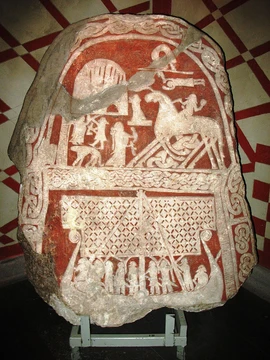
Ragnarok
Foretold battle and rebirth of the Norse gods and world.

Ragnarök is a foretold series of impending events in Norse mythology, including a great battle in which numerous major mythological figures perish, catastrophic natural disasters, the burning of the world, and its submersion underwater. After these events, the world rises again, cleansed and fertile, repopulated by two human survivors, Líf and Lífþrasir. The event is attested primarily in the Poetic Edda and the Prose Edda, and has been the subject of scholarly discourse in Germanic studies.
- Attested in
- Poetic Edda (13th century) and Prose Edda (13th century, by Snorri Sturluson)
- Also known as
- Ragnarøkkr (Twilight of the Gods)
- Key figures perishing
- Odin, Thor, Týr, Freyr, Heimdall, Loki
- Human survivors
- Líf and Lífþrasir
- Etymology
- From Old Norse 'ragna' (gods) and 'rök' (fate/destiny) or 'røkkr' (twilight)
Lore & Background
The event is described in the Poetic Edda poem Völuspá, where a völva recites to Odin the sequence of Ragnarök from stanza 40 to 58. It includes three roosters crowing, the hound Garmr breaking free, Heimdall blowing the Gjallarhorn, and the ship Naglfar setting sail. The gods battle invaders: Odin is swallowed by Fenrir, Thor kills Jörmungandr but dies from its venom, and Freyr loses to Surtr. The earth sinks into the sea, stars vanish, and flames touch the heavens. Afterward, the earth reappears, fields grow without sowing, and the gods Höðr and Baldr return from Hel.
Reader's Guide
Ragnarök is a central event in Norse mythology, representing both destruction and renewal. Its significance lies in its detailed narrative of cosmic collapse and rebirth, influencing later Germanic studies and popular culture. The term 'Ragnarøkkr' (Twilight of the Gods) was popularized by Richard Wagner's opera Götterdämmerung, though this interpretation may stem from a folk etymology. The event is preserved in 13th-century Icelandic manuscripts, reflecting pre-Christian traditions. Its themes of fate, sacrifice, and regeneration continue to resonate in modern fantasy and scholarly analysis.
Did You Know?
- The event is also referred to as 'aldar rök' (end of an age) in the poem Vafþrúðnismál.
- The human survivors Líf and Lífþrasir hide in the forest Hoddmímis holt during Ragnarök.
- Thor's sons Móði and Magni will possess the hammer Mjolnir after Ragnarök.
- The dragon Níðhöggr appears in the final stanza of Völuspá, flying with corpses in his jaws.
Common Misconceptions (Editorial)
- A common misconception is that Ragnarök is solely an "end of the world" event, with no aftermath. In fact, the lore states that after the earth sinks into the sea and the world burns, it rises again, cleansed and fertile, and is repopulated by the human survivors Líf and Lífþrasir. - Some believe that all gods perish permanently. However, according to the facts, the gods Höðr and Baldr return from Hel after Ragnarök, and Thor's sons Móði and Magni survive to possess the hammer Mjolnir.
Why It Matters (Editorial)
Ragnarök endures because it reflects a universal human concern with cycles of destruction and renewal, offering a narrative where even the gods face mortality. Its vivid imagery—from Fenrir swallowing Odin to the world rising again—has inspired countless modern works, showing how ancient myth continues to shape our stories about fate, sacrifice, and hope.
Spotted an error? Know more?
This is a living reference — every entry is fact-audited, and reader corrections feed straight into our audit queue. Suggest an edit · See this site's audit record