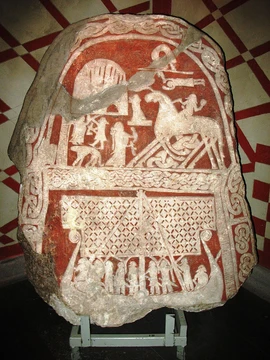
Asgard
Fortified home of the Æsir gods in Nordic mythology.

Asgard (Old Norse: Ásgarðr; 'Enclosure of the Æsir') is a location associated with the gods in Nordic mythology. It appears in several Old Norse sagas and mythological texts, including the Eddas, and is described as the fortified home of the Æsir gods, often associated with gold imagery and containing other locations such as Valhöll, Iðavöllr, and Hlidskjálf. It is the equivalent of Mount Olympus of Greek Mythology.
- also_known_as
- Ásgarthr, Ásgard, Ásegard, Ásgardr, Asgardr, Ásgarth, Asgarth, Esageard, Ásgardhr
- mythology
- Nordic
- associated_with
- Æsir gods
- notable_locations_within
- Valhöll, Iðavöllr, Hlidskjálf, Glaðsheimr, Vingólf, Glasir
- bridge
- Bifröst
- euhemeristic_identification
- Troy or a city in Asia
Lore & Background
Asgard is named twice in Eddic poetry: in Hymiskviða, when Thor and Týr journey from Asgard to Hymir's hall, and in Þrymskviða, when Loki claims jötnar would soon live in Asgard without Mjölnir. In the Prose Edda's euhemeristic prologue, Snorri Sturluson portrays Asgard as the town of Troy before Greek warriors overtook it, with Trojans later moving to northern Europe. In Gylfaginning, Snorri describes the gods building Asgard in the centre of the world after creation, identifying it as Troy, and within it constructing Glaðsheimr at Iðavöllr, a gold-like hall with a high seat for Odin and twelve seats for other gods, as well as Vingólf for female gods and a forge.
Reader's Guide
Asgard is a central cosmological location in Old Norse religion, though its depiction is often vague and contradictory. Snorri places Asgard in the centre of the world, surrounded by Midgard and jötnar lands, all encircled by the sea, and also locates the gods' homes in the heavens. Some scholars debate whether the gods were conceived as living in the heavens, with some arguing Snorri presents a Christian-influenced framework not seen in Eddic or skaldic poetry. An alternative proposal views the world as realms connected by passages not typically traversed, explaining how Asgard can be located both east and west of the realm of men, over the sea, and over Bifröst. The tendency to link Asgard to Troy is part of a wider European cultural practice of claiming Trojan origins, seen in works like the Aeneid and Geoffrey of Monmouth's Historia regum Britanniae.
Did You Know?
- The compound word Ásgarðr combines Old Norse áss ('god') and garðr ('enclosure').
- In some euhemeristic accounts, Asgard is portrayed as being a city in Asia or Troy.
- In Gylfaginning, the gods built a hof named Glaðsheimr at Iðavöllr in the centre of Asgard, described as like gold both inside and outside.
- The bridge Bifröst is commonly interpreted as the bridge to Asgard, spanning from the heavens to the earth.
Common Misconceptions (Editorial)
Some misconceptions include that Asgard is exclusively a celestial realm, but the facts note that Snorri Sturluson euhemeristically identified Asgard with the earthly city of Troy. Another misconception is that Bifröst is a literal rainbow bridge connecting Asgard to Midgard; while commonly interpreted as such, the facts state it is "commonly interpreted" as a bridge spanning from heavens to earth, not as a definitive rainbow. A third misconception is that Asgard is only mentioned in later sources, but the facts confirm it appears in Eddic poetry such as Hymiskviða and Þrymskviða.
Why It Matters (Editorial)
Asgard endures as a cultural touchstone because it represents the idealized, fortified home of the gods in Nordic mythology, embodying themes of order, power, and gold-bedecked majesty that have captivated storytellers for centuries. Its euhemeristic connection to Troy also highlights how ancient peoples sought to link their myths with classical history, giving Asgard a lasting resonance in both scholarly study and popular imagination.
Spotted an error? Know more?
This is a living reference — every entry is fact-audited, and reader corrections feed straight into our audit queue. Suggest an edit · See this site's audit record